The Massachusetts Bay Transportation Authority’s signal priority implementation led to buses spending an average of 21 percent less time waiting at red lights.
Source: 2025-B01960
Taxonomy: Public Transportation → Transit Signal Priority (PT09)
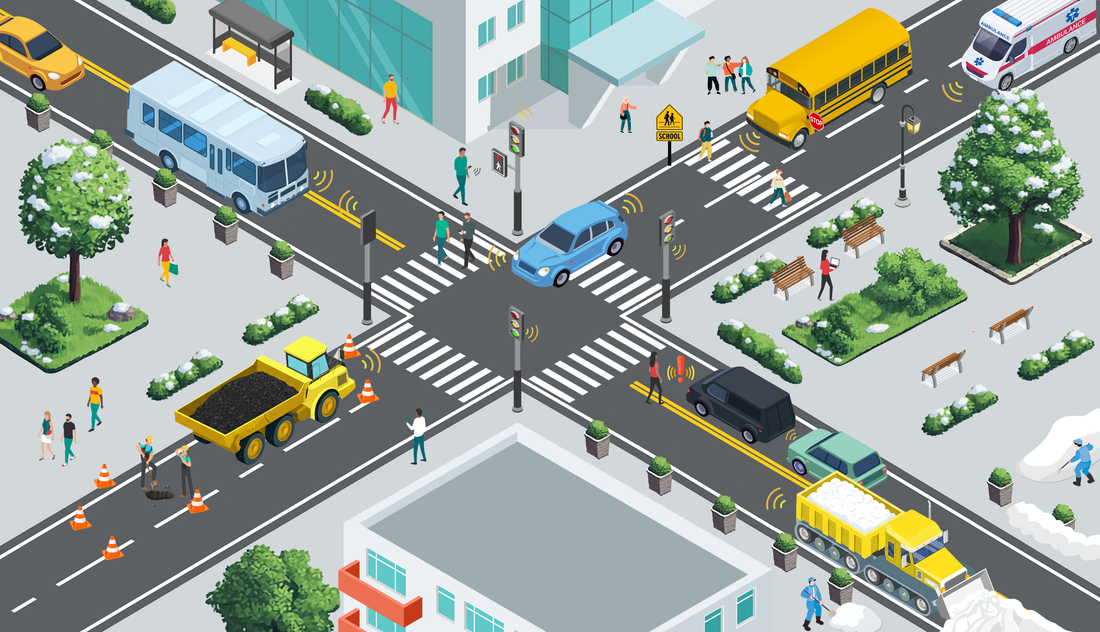
V2X is a communication technology that enables vehicles to wirelessly exchange information with other vehicles (vehicle-to-vehicle [V2V]), infrastructure (vehicle-to-infrastructure [V2I]), and personal devices (vehicle-to-pedestrians [V2P]). This visualization focuses on V2X benefits primarily for use cases on arterials and at signalized intersections, aiming to improve situational awareness, road safety, and traffic efficiency.
 1
2
3
4
5
6
7
8
1
2
3
4
5
6
7
8
Tips for Using the Visualization: Click an icon in the panel on the left to filter the V2X applications.
Transit signal priority (TSP) using V2X leverages real-time communication to adjust traffic signal timing or phasing when transit vehicles are present, with the potential to improve both reliability and travel time.
Benefit Examples:
The Massachusetts Bay Transportation Authority’s signal priority implementation led to buses spending an average of 21 percent less time waiting at red lights.
Source: 2025-B01960
Taxonomy: Public Transportation → Transit Signal Priority (PT09)
A simulation study using AI-based transit signal priority reduced average person delay by 18.77 percent during peak hours and 23.37 percent during off-peak hours compared to pretimed signal control.
Source: 2026-B02032
Taxonomy: Public Transportation → Transit Signal Priority (PT09)
V2X technology enables wireless communications among vehicles, roadside infrastructure, and vulnerable road users equipped with mobile devices. High volume, multimodal intersections are key candidates for V2X deployments geared toward pedestrian safety.
Benefit Examples:
When using infrastructure-based sensors at intersections to provide safety guidance to vehicles and vulnerable road users, a simulation study in California found a 99 percent lower crash count compared to the no-technology case where passenger cars turned right into the pedestrian’s path.
Source: 2022-B01689
Taxonomy: Vehicle Safety → Vulnerable Road User Safety (VS12)
Of participants with vision disabilities in a study in New York City, 71 percent felt more confident in their ability to cross signalized intersections while using a P2I mobile app with audio alerts and haptic prompts, compared to other assistive technologies.
Source: 2022-B01695
Taxonomy: Vehicle Safety → Vulnerable Road User Safety (VS12)
The Tampa Hillsborough Expressway Authority (THEA) Connected Vehicle (CV) Pilot Deployment’s pedestrian collision warning implementation contributed to preventing 24 pedestrian crashes in the Downtown Tampa study area.
Source: 2026-B02022
Taxonomy: Vehicle Safety → Vulnerable Road User Safety (VS12)
A V2X prototype tested on a university campus in Indiana showed that connected and automated vehicles equipped with traffic scanning technology improved smooth stopping behavior by 62.9 percent upon detecting pedestrians.
Source: 2024-B01862
Taxonomy: Vehicle Safety → Vulnerable Road User Safety (VS12)
A C-V2X-enabled smart intersection pilot in Texas found that integrating connected vehicle, roadside unit (RSU), and pedestrian alert technologies increased pedestrian/bicyclist perception of safety by up to 88 percent based on survey results.
Source: 2025-B01990
Taxonomy: Vehicle Safety → Vulnerable Road User Safety (VS12)
V2X data collected in school zones can provide real-time alerts and warnings to drivers that do not reduce speeds in those zones, aiding in compliance.
Benefit Examples:
In a Florida DOT study, a school zone alert app on drivers’ smartphones lowered the probability of speeding when the app alerts were activated.
Source: 2021-B01532
Taxonomy: Public Transportation → Transit Pedestrian Indication (PT11)
A connected vehicle demonstration in Columbus, Ohio, deployed V2X technology in 1,000 vehicles and 85 signalized intersections, resulting in an increase in compliance with posted school zone speed limits from 18 to 56 percent.
Source: 2022-B01674
Taxonomy: Vehicle Safety → V2V Basic Safety (VS02)
A pilot study of two connected school buses in Alpharetta, Georgia, found that TSP increased their travel speeds by 18 percent and reduced the number of unnecessary stops by 40 percent.
Source: 2023-B01804
Taxonomy: Public Transportation → Transit Signal Priority (PT09)
V2X-based corridor signal optimization aims to enhance traffic flow on signalized arterial roadways. It employs V2X communications with intersection geometry, signal phase, and timing and queue information to better understand traffic conditions and improve traffic efficiency.
Benefit Examples:
An adaptive traffic management system field tested in two intersections in Colorado Springs using radar, LiDAR, video analytics, and V2X equipment reduced traffic delay by up to 23.7 percent.
Source: 2025-B01989
Taxonomy: Traffic Management → Traffic Signal Control (TM03)
Modeling of a seven-mile corridor in Houston, Texas, found that V2X-based corridor signal optimization, Traffic Optimization for Signalized Corridor (TOSCo) applications, can reduce vehicle stop delays by approximately 50 percent as TOSCo market penetration increases.
Source: 2023-B01741
Taxonomy: Traffic Management → Traffic Signal Control (TM03)
V2X for snowplows and heavy vehicles, enabling functions such as signal preemption and real-time safety messages, facilitates communication with infrastructure and other road users to enhance safety, coordination, and operational efficiency, particularly during roadway maintenance and adverse weather conditions.
Benefit Examples:
A field test of snowplows in the Salt Lake City, Utah, metropolitan area found that V2X-equipped routes had a larger reduction in crash rates (up to 3.87) than their non-equipped counterparts (1.82).
Source: 2023-B01752
Taxonomy: Weather → Weather Data Collection (WX01)
Driving aids enabled by communications between vehicles, such as forward collision and lane changing warnings, are designed to assist drivers during critical tasks and increase situational awareness of surrounding traffic.
Benefit Examples:
The Tampa Hillsborough Expressway Authority’s CV Pilot showed a 9 percent decrease in the rate of forward collision conflicts with its V2X-enabled warning system installed in participant’s vehicle rearview mirrors.
Source: 2021-B01583
Taxonomy: Vehicle Safety → Autonomous Vehicle Safety Systems (VS01)
A driving simulator study incorporating a hurricane scenario conducted in Louisiana found that time to collision increased by 15.1 percent with vehicle-to-vehicle warnings compared to the base scenario.
Source: 2025-B01962
Taxonomy: Vehicle Safety → V2V Basic Safety (VS02)
By alerting drivers and other vehicles to the presence of work zones, V2X technologies such as queue warning systems and automated truck mounted attenuators can be used to help separate workers from threats to their operations.
Benefit Examples:
Indiana DOT found that situating V2X-equipped queue trucks with digital alerts ahead of interstate work zones helped slow driver speeds and reduced hard-braking events by 80 percent.
Source: 2023-B01745
Taxonomy: Vehicle Safety → Queue Warning (VS08)
A connected vehicle deployment to help protect roadside workers in Connecticut found that cloud-based alerts lowered drivers’ risk of collision by 90 percent and reduced hard-braking by roadside incidents by 80 percent.
Source: 2024-B01868
Taxonomy: Vehicle Safety → Autonomous Vehicle Safety Systems (VS01)
Missouri DOT’s pilot program of a leader-follower truck mounted attenuator (TMA) system, in which the follower vehicle is automated to reduce worker injuries, found that the system effectively managed gap distances between vehicles, with an average between actual and desired of −3.21 feet for mobile work zones in Kansas City.
Source: 2023-B01787
Taxonomy: Maintenance and Construction → Work Zone Management (MC06)
V2X technology for emergency vehicle preemption enables real-time communication between emergency vehicles and traffic signals to grant priority passage, reducing response times and improving safety at intersections.
Benefit Examples:
The emergency vehicle preemption application using connected vehicle technology improved average speed and travel time when preemption was granted, reducing travel time by up to 5.6 seconds, with an average reduction of 1.64 seconds.
Source: 2022-B01674
Taxonomy: Public Safety → Emergency Vehicle Preemption (PS03)
Simulation results suggested that incorporating vehicle trajectory data into emergency vehicle preemption systems could help reduce critical response times and potentially save around 3,000 lives each year in the United States.
Source: 2025-B01968
Taxonomy: Public Safety → Emergency Vehicle Preemption (PS03)
An emergency vehicle preemption system using V2I communication in Seminole County, Florida led to average response time reductions of 90 seconds and saves an estimated $200,000 annually.
Source: 2025-B01994
Taxonomy: Public Safety → Emergency Vehicle Preemption (PS03)